ASEAN Deputy Secretary-General: Inclusive innovation, stronger partnerships key to accelerating poverty reduction
Chinagate.cn by Jin Ling, November 14, 2026 Adjust font size:
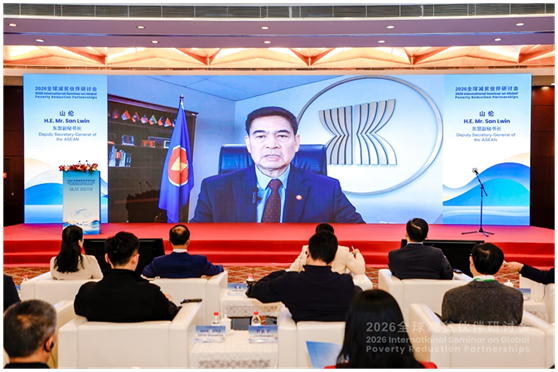
A pre-recorded video message by San Lwin, deputy secretary-general of ASEAN, plays during the opening ceremony of the 2026 International Seminar on Global Poverty Reduction Partnerships. The seminar was held in Beijing on Nov. 11, 2026.
Stronger partnerships and inclusive innovation are essential to accelerating poverty reduction and ensuring that the benefits of development reach vulnerable communities, San Lwin, deputy secretary-general (DSG) of the Association of Southeast Asian Nations (ASEAN), stated at the 2026 International Seminar on Global Poverty Reduction Partnerships that was held in Beijing on Nov. 11 this year.
San Lwin [editor's note: Myanmar does not have surnames, and a citizen's entire name is usually used] emphasized the importance of turning shared commitments into practical solutions that help facilitate tangible improvements in people's lives. He noted that poverty remains multidimensional and is increasingly intertwined with climate change, economic uncertainties, and widening inequalities and called for sustained and coordinated efforts in order to address these challenges.
ASEAN has made encouraging progress in poverty reduction, with the proportion of its population living below the national poverty line declining from 13.3% in 2016 to 10.8% in 2023. San Lwin indicated that further efforts are needed to sustain and accelerate the progress that has been made, however.
Guided by the ASEAN Community Vision 2045, ASEAN remains committed to a people-centered and inclusive development agenda, with the aim of ensuring that the benefits of economic growth are shared more equally and that vulnerable communities have better access to opportunities and essential services.
The DSG highlighted three priorities for advancing this agenda: strengthening partnerships, promoting inclusive innovation, and translating knowledge into action.
With regard to partnerships, he cited the ASEAN Public-Private-People Partnership Forum on Rural Development and Poverty Eradication, which provides a platform that helps enable governments, the private sector, civil society, and local communities bring together their respective strengths and resources in support of inclusive and sustainable development.
San Lwin also highlighted ASEAN initiatives that encourage community-driven innovation, including the ASEAN Rural Development and Poverty Eradication Leadership Awards and the ASEAN Village Network. The ASEAN Village Network helps rural communities make better use of local resources, adopt innovations, and develop sustainable livelihood opportunities suited to their local circumstances through various initiatives, including what are known as Digital Villages and One Village One Product, he stated.
In addition, San Lwin pointed to the establishment of Centers of Excellence for micro-, small, and medium-sized enterprises (MSMEs) in the midst of green transitions as an example of how regional cooperation can help businesses build the knowledge and capacity that they need in order to adopt sustainable practices, enhance competitiveness, and achieve greater market access.
He stressed that shared experience and expertise must be translated into concrete opportunities for inclusive and sustainable growth.
ASEAN looks forward to further strengthening cooperation with international partners in order to advance inclusive development and accelerate poverty eradication, San Lwin concluded while also expressing hope that the International Seminar on Global Poverty Reduction Partnerships would serve as a catalyst for concrete action toward a more resilient, inclusive, and prosperous future.
Themed "Deepening Partnerships and Innovating Poverty Reduction Pathways," the 2026 International Seminar on Global Poverty Reduction Partnerships was jointly organized by the International Poverty Reduction Center in China (IPRCC), the China Internet Information Center (CIIC), and three United Nations Rome-based Agencies – the Food and Agriculture Organization of the United Nations (FAO), the International Fund for Agricultural Development (IFAD), and the World Food Programme (WFP). This is an annual event launched in 2017 with the goal of sharing relevant experience and information and exploring cooperation models.