SCO official: Regional-global cooperation key to advancing poverty reduction
Chinagate.cn By Jin Ling, November 14, 2026 Adjust font size:
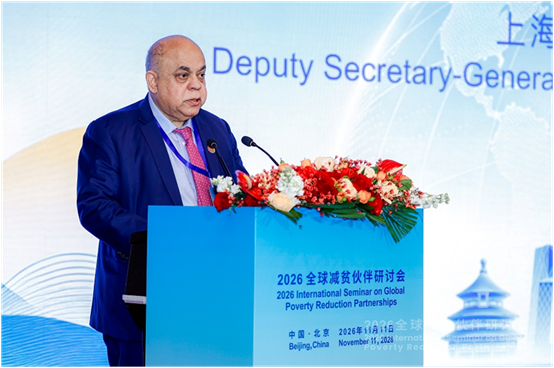
Sohail Khan, deputy secretary-general (DSG) of the Shanghai Cooperation Organization, delivers an opening speech at the 2026 International Seminar on Global Poverty Reduction Partnerships. The seminar was held in Beijing on Nov. 11.
No country can tackle poverty alone, and stronger coordination between regional organizations and global institutions is essential to achieving sustainable progress in poverty reduction, Sohail Khan, deputy secretary-general (DSG) of the Shanghai Cooperation Organization (SCO), stated at the 2026 International Seminar on Global Poverty Reduction Partnerships that was held in Beijing on Nov. 11. He thus called for closer international cooperation, greater resource mobilization, and stronger knowledge-sharing mechanisms in order to address persistent poverty and accelerate progress toward the United Nations Sustainable Development Goals (SDGs).
Khan noted that poverty continues to affect millions of people worldwide, limiting access to employment, nutritious food, healthcare, and education and that Women, young people, older persons, and populations in remote rural areas and regions with unfavorable natural and climatic conditions are particularly vulnerable.
He emphasized that addressing these challenges requires coordinated international action, with poverty reduction and development remaining high on the global agenda. The DSG also highlighted the close alignment between the SCO Development Strategy and the UN 2030 Agenda for Sustainable Development, under which poverty eradication is identified as the first Sustainable Development Goal.
Khan said that cooperation with regard to the development of rural and remote areas is an important priority for the SCO and that SCO member states have been promoting cooperation related to agriculture, traditional medicine, digital economy development, and digital infrastructure in order to address the fact that many vulnerable communities face difficulties accessing education, healthcare, financial services, and other essential resources.
The SCO has also taken steps to institutionalize poverty reduction cooperation among its member states. In 2022, an event known as the Meeting of Heads of Ministries and Agencies of SCO Member States on Poverty Reduction was held in Tashkent, the capital of Uzbekistan, marking the beginning of a more structured cooperation framework in this area.
In 2023, Pakistan spearheaded the formation of the SCO Special Working Group on Poverty Reduction, and it initiated its activities. The group was established in order to support the implementation of SDG 1 and move poverty reduction cooperation from fragmented initiatives toward a more institutionalized approach. The working group has facilitated practical cooperation among member states, including joint analysis of pension systems and ongoing expert exchanges on improving support systems for vulnerable groups since it was established.
Khan stressed that regional cooperation alone cannot fully address the global challenge of poverty, however, and that stronger links to international initiatives are required. In this regard, he welcomed the establishment of the Global Partnership for Poverty Alleviation and Development (GPPAD), expressing the SCO's readiness to share its experience and institutional mechanisms with the partnership and participate in joint projects and indicating that potential areas of cooperation include experience-sharing, specialist training and joint research. Established in the first half of 2026 and unveiled during the 2026 International Seminar on Global Poverty Reduction Partnerships, the GPPAD is an initiative that promotes exchanges of experience pertaining to poverty reduction and governance and the exploration of methods of eradicating poverty and pursuing sustainable rural development that was spearheaded by China, 53 other countries, and nine international organizations and welcomes the participation of governments, international organizations, the private sector, academia and media institutions.
Khan proposed five priorities that can help strengthen international poverty reduction efforts: improving coordination between regional organizations and global institutions, particularly with regard to data-sharing and the exchange of successful practices; investing in education and human resource development, especially for women and young people; promoting innovation and entrepreneurship through affordable technologies suited to local communities; strengthening South-South and triangular cooperation; and expanding joint pilot projects among SCO member states, particularly involving neighboring countries.
He noted that such pilot projects can help support disadvantaged villages and communities through improved access to basic services and infrastructure, including drinking water, transport, education, healthcare facilities, and agricultural skills development and that this can help improve sustainable production.
The SCO's DSG reaffirmed his organization's commitment to expanding cooperation with international partners under the GPPAD framework, emphasizing the importance of both sharing its own experience and learning from the practices of other organizations and countries.
His remarks underscored the fact that stronger connections between regional and global cooperation mechanisms, combined with practical knowledge-sharing and coordinated action, are essential to advancing poverty eradication and achieving sustainable development worldwide.
Themed "Deepening Partnerships and Innovating Poverty Reduction Pathways," the 2026 International Seminar on Global Poverty Reduction Partnerships was jointly organized by the International Poverty Reduction Center in China (IPRCC), the China Internet Information Center (CIIC), and three United Nations Rome-based Agencies – the Food and Agriculture Organization of the United Nations (FAO), the International Fund for Agricultural Development (IFAD), and the World Food Programme (WFP). This is an annual event launched in 2017 with the goal of sharing relevant experience and information and exploring cooperation models.