Tsinghua University brings China's rural food heritage to World Food Forum
Chinagate.cn by Sun Xin and Jin Ling, October 23, 2026 Adjust font size:
On Oct. 14, an exhibition exploring China's rural biocultural heritage and food traditions opened in Rome at the headquarters of the Food and Agriculture Organization of the United Nations (FAO) during the 2026 World Food Forum. Curated by Zhao Daqi, a researcher at Tsinghua University's Institute for Rural Construction (THUIRC) and director of the Entrepreneurship Center at the university's Rural Revitalization Workstation, the exhibition showcases Tsinghua University's Rural Innovation+ program, a flagship talent-development and startup-incubation initiative designed to support rural revitalization in China that was launched in 2021 and is also known as Xiangchuang+, and highlights practical, youth-driven approaches to preserving agricultural knowledge and promoting sustainable food systems.
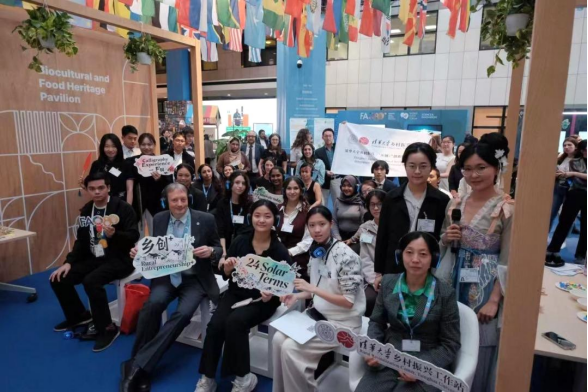
Participants and attendees pose for a photo at the "Touching Time, Exploring the World: Biological Culture and Food Heritage" exhibition on Oct. 14, the opening day of the event. Themed on China's rural biocultural heritage and food traditions, the exhibition was held at the headquarters of the Food and Agriculture Organization of the United Nations (FAO) during the 2026 World Food Forum, in Rome, Italy.
Known as "Touching Time, Exploring the World: Biological Culture and Food Heritage," the exhibition was organized around China's lunisolar calendar, a traditional calendar with 24 solar terms that has long guided agricultural practices in the country and other parts of Asia, and drew on the work of Tsinghua University's Rural Revitalization Workstation, which supports student-designed community hubs in villages across China. The exhibition featured three thematic sections: "Dietary Heritage and Agrarian Wisdom," "Biological Resources and Intangible Cultural Heritage," and "outh Innovation and Green Design."
Li Na, counselor at the Permanent Mission of the People's Republic of China to the UN Agencies for Food and Agriculture, highlighted the role of young people during the event's opening ceremony.
"They are protecting tradition in the fields, in the labs, and in the markets rather than simply in a museum, thus making the preservation live, trendy and global," she stated.
Li added that China stands ready to deepen youth empowerment and technical cooperation with the FAO.
Reuben Sessa, senior program officer at the FAO Office of Youth and Women, emphasized that food security is rooted in rural vitalization, cultural heritage, and the ingenuity of the people who grow food during a keynote address that he delivered. Sessa also underscored the importance of empowering rural women and connecting young people with digital innovation as part of the process of building resilient food systems.
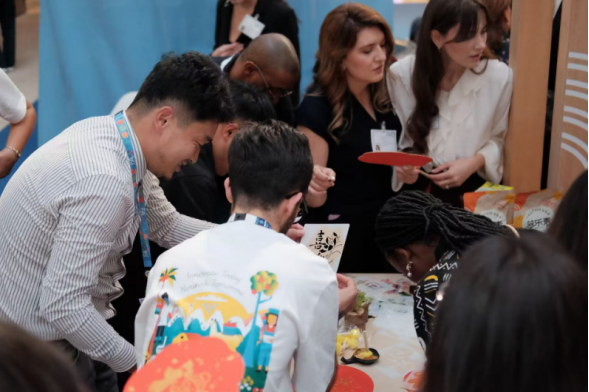
Visitors practice traditional Chinese calligraphy at the "Touching Time, Exploring the World" exhibition.
The Rural Revitalization Practice Report: Sharing the Contributions of Tsinghua University Youth to China's Rural Revitalization was also released at the event. Based on research led by Professor Zhang Hong's Tsinghua University team, the report examines innovation and entrepreneurship at the university's Rural Revitalization Workstation and describes how the Rural Innovation+ program has helped shift village development beyond construction of purely physical space toward an integrated approach encompassing space, talent and industry.
The exhibition was initiated by Tsinghua University's Rural Revitalization Workstation; co-hosted by Tsinghua University's Center for Global Competence Development, the FAO Office of Youth and Women (OYW), and the World Food Forum (China); jointly organized by the UNDP SDG Innovation Lab (SPARK Lab)in Chengdu; and received support from the China Internet Information Center (CIIC), Dolphin Books, and the CAST(China Association for Science and Technology) -UN Consultative Committee on Women Scientists and Gender Equality and Solidarity.