Knowledge beyond sight: China's first visually impaired communication doctor reshapes digital accessibility studies
Chinagate.cn By Jin Ling, July 27, 2026 Adjust font size:
On June 25, Cai Cong, China’s first visually impaired PhD holder in communication, walked onto the stage at the University of Chinese Academy of Social Sciences’ (UCASS) doctoral degree conferral ceremony that was underway, guided by a fellow graduate and his white cane. Before he started the program, he was able to use two computers to take the entrance exam – one that played the questions verbally and one that he typed the answers into. The other people who took the exam read the questions on a computer screen and were required to write their answers by hand.
“[Such arrangements] show what reasonable accommodation actually looks like,” his doctoral advisor, professor Bu Wei, explained after the ceremony. “It isn’t charity, but institutional adjustment that makes equality possible.”
The significance of the moment extended far beyond Cai’s doctorate, however. Long before enrolling in his doctoral program, Cai had already spent about a decade conducting disability studies alongside academics while engaging in China’s disability rights advocacy. His PhD did not transform him from a research subject into a researcher. Instead, it empowered this long-standing practitioner-researcher to develop a set of theoretical concepts and analytical frameworks to explain how the visually impaired community has shaped the historical development of digital accessibility for people with visual impairments.
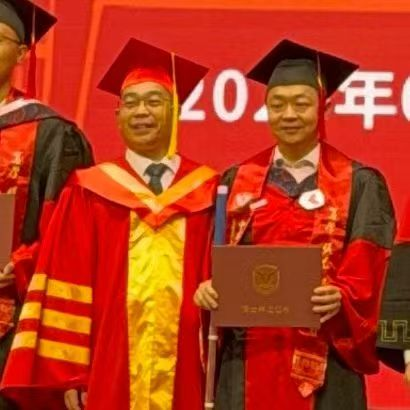
Cai Cong (right), China’s first visually impaired PhD in communication, poses for a photo with Feng Shizheng (left), president of the University of Chinese Academy of Social Sciences (UCASS), during the university’s 2026 doctoral graduation ceremony. [Photo courtesy of UCASS Professor Bu Wei]
From personal experience to public advocacy
Cai lost most of his vision after developing medication-induced glaucoma at the age of 10. He did not regard his impairment as a defining trait until China’s national college entrance examination (“Gaokao”) made the education system his primary obstacle.
In 2004, while preparing for the following year’s Gaokao, his school submitted a request to provincial education authorities for an on-site reader to narrate exam questions for him. The request was rejected due to the absence of established precedents.
Two months later, an unexpected discovery altered the course of his education: Cai’s father stumbled upon a newspaper article about Changchun University’s School of Special Education. Before that moment, neither Cai nor his family members knew such educational opportunities available for visually impaired students. He enrolled in the school in 2005, majoring in acupuncture and massage– one of the few university programs available to visually impaired students in China at that time.
After he graduated, Cai spent more than a decade at a disability rights NGO, focusing on public communication, social advocacy and policy engagement. During that time, he witnessed– and helped advance– a series of important reforms in educational accessibility. In 2014, China introduced the first Braille version of the Gaokao, and the following year, the Ministry of Education issued regulations allowing visually impaired candidates to choose Braille or large-print exam papers.
While these reforms expanded visually impaired students’ access to higher education, they also revealed the limits of existing accommodation measures. By treating Braille and large-print papers as universal solutions, policymakers overlooked the growing importance of digital accessibility for people who relied on screen readers rather than Braille. For most people who lose their sight adulthood, Braille is not a practical option. Though basic Braille can be learned relatively quickly, achieving reading and writing fluency often takes years, while large-print materials remain unusable for those with profound vision loss.
Starting in 2013, Cai became an active participant in collaborative research on disability and communication. Working with professor Bu Wei and her colleagues on projects supported by organizations such as the International Labour Organization and the United Nations Educational, Scientific and Cultural Organization, he received training covering research methods, qualitative coding, and content analysis while contributing knowledge drawn from disability communities and advocacy practice.
Over the following eight years, he co-authored research, participated in international projects, and gradually established an independent research agenda -- well before formally starting his doctoral studies.
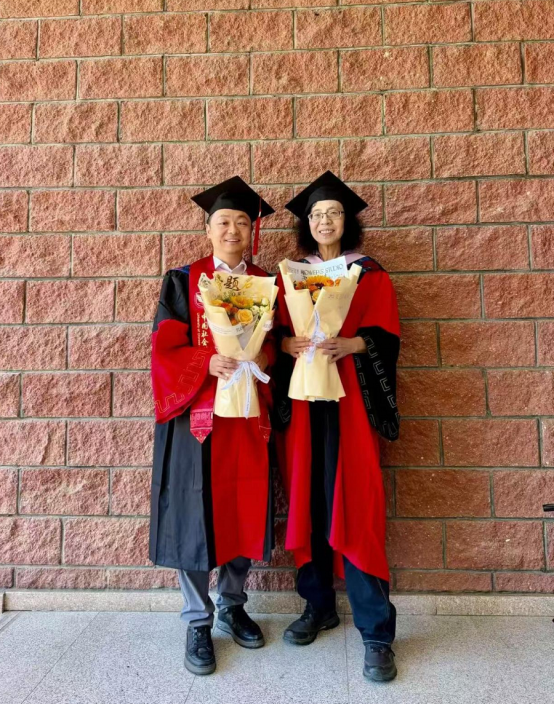
Cai (left) poses for a photo with his doctoral advisor, professor Bu Wei, after graduating. [Photo courtesy of Bu Wei]
The hidden costs of academic life
UCASS rolled out reasonable accommodations for Cai during its 2021 and 2022 doctoral entrance examinations, marking the university’s first provision of reasonable accommodation in its admissions process. Cai was permitted to type his examination answers on a computer instead of writing them by hand. He was not able to pass the 2021 examination, but he tried again and was admitted in 2022. The accommodation was meaningful not because it offered special treatment, but because it removed barriers that had long prevented talented scholars with disabilities from competing on equal terms.
Returning to academia meant confronting new barriers. Even with formal accommodations, research itself remained very time-consuming. Disability scholars describe this invisible surcharge of time and effort required to navigate inaccessible environments as the “disability tax.”
While sighted peers skim through books or organize citations visually and efficiently, Cai listens to every single sentence via screen-reading software. Any lapse in focus means replaying entire sections. Inaccessible databases and verification systems cost him hours of extra work that researchers without disabilities never need to spend.

Cai (front row, fourth from left) celebrates his graduation with friends and family members. [Photo courtesy of Bu Wei]
Rewriting the history of digital accessibility
Building on more than a decade of collaborative research, community practice, and disability advocacy, Cai completed his doctoral dissertation, Technological Juyi and the Emergence of Digital Subjectivity Among People with Visual Impairments: A Study of Social History of Chinese Screen Reading Technology (1979-2009), which was awarded UCASS’s Outstanding Doctoral Dissertation Award.
Combining archival materials and life-history interviews, Cai reconstructs three decades of technological evolution from the perspective of China’s visually impaired community. His research demonstrates that people with visual impairments are not merely recipients of assistive technologies. Instead, they have modified software, disseminated technical knowledge through informal networks, reported bugs, provided peer support, and trained newcomers, thereby driving the development, maintenance, and popularization of screen-reading technologies.
Cai uses the term “techno-Juyi(聚义)” to define this process. He deliberately retains the original Chinese term in English writing, rather than adopting approximate English equivalent, to preserve its inherent cultural and historical connotations. In traditional Chinese culture, “Juyi” originates from the classic novel “Water Margin” [written during the early Ming Dynasty period (1368-1644), one of the Four Unique Classical Novels of Chinese literature]. It describes how groups form alliances rooted on “Yi (义),” a moral commitment encompassing loyalty, reciprocity, and shared responsibility, rather than formal institutional ties or egalitarian association.
Accordingly, “techno-Juyi” refers to a dynamic network through which structurally marginalized actors, organized around a critical technological intermediary, continuously co-create knowledge, technical practices and collective capabilities through collaboration, feedback, exchange, emotional recognition and strategic competition. The prefix “techno” emphasizes that the formation of alliances, the emergence of authority, and the production of meaning are all shaped by the material logic of specific technological infrastructures. In this sense, “techno-Juyi” represents collective technological practice rooted in a unique historical context: participants act not merely as users but also as testers, instructors, maintainers, organizers, and contributors, jointly advancing the evolution of digital accessibility for visually impaired community.
The dissertation also makes broader theoretical and methodological contributions. It introduces the concept of parasitic media infrastructure to describe the position of screen readers within broader digital ecosystems and develops a multidimensional analytical framework integrating social relations, technological infrastructures, and political dynamics to explain how marginalized communities produce digital subjectivity through collective technological practice.
Methodologically, the study combines archival research with life-history interviews. Because the historical development of screen-reading software is scarcely documented in official archives, Cai treats interviews not only as supplementary evidence, but also as a way of reconstructing historical processes with community members whose daily technological practices have long been overlooked by formal records.
His research also advances academic discussions on reflexivity in disability studies. As a visually impaired researcher studying his own community, Cai examines how knowledge is produced through ongoing relationships among researchers, participants, and communities, emphasizing that relationality is built through concrete interaction and long-term collaboration, rather than being defined as a fixed category.
Working with Cai reshaped Bu’s own understanding of accessibility as well. She emphasizes that accessibility is not limited to removing physical barriers. It is crucial to create equal development opportunities through reasonable accommodation and to rethink institutional assumptions about who can qualify as an academic scholar.
Throughout Cai’s doctoral journey, Bu intentionally avoided framing him as an inspirational figure who “overcame his disability.”
Instead, she always asked him one question: “Do you enjoy the process of writing your dissertation?”
“As long as you love what you are doing, you’re already writing an excellent dissertation,” she continued.
The day after receiving his doctorate, Cai returned to work at the Cripping Future Institute, an organization he founded to bridge academic researchers and disability communities.
“I want to help people with disabilities express their own perspectives,” Cai noted in late June. “My role is to be a supporter– helping them transform lived experience into knowledge that can be shared.”
Cai also hopes to encourage more scholars to conduct in-depth, direct engagement with disability communities, so as to better understand their rights and subjectivity.