From sand to gold: How a desert county in China is rethinking the fight against desertification
Chinagate.cn By Sunxin, June 18, 2026 Adjust font size:
From June 5 to June 6, the Sci-Tech Empowering Rural Transformation: 2026 Climate Resilience and Green Transition Dialogue was held in Jinta county, Jiuquan city, Gansu province, in northwest China. Building on the outcomes and networks established through previous events in the series, the dialogue combined thematic discussions with field visits across various sites in Jiuquan, showcasing scalable, innovative practices that contribute to the United Nations Decade on Ecosystem Restoration (2021–2030) and support national pathways toward carbon neutrality and climate-resilient development.
Gabriel Moreti, a Brazilian graduate student at China Agricultural University, was one of the participants, and what he saw and witnessed challenged his assumptions. “A border,” he wrote in his field report, describing the boundary between the encroaching desert and the vast stretches of drought-adapted saxaul trees. “On one side, desert; on the other, green.” The scale of the vegetation surprised him as well as the economic logic quietly woven into it.
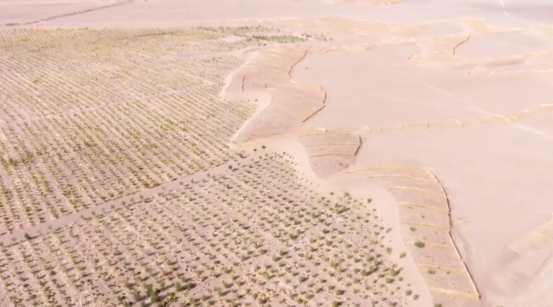
An aerial view of the boundary between the desert and a saxaul (Haloxylon ammodendron) plantation in Jinta county, Jiuquan city, Gansu province, on June 5
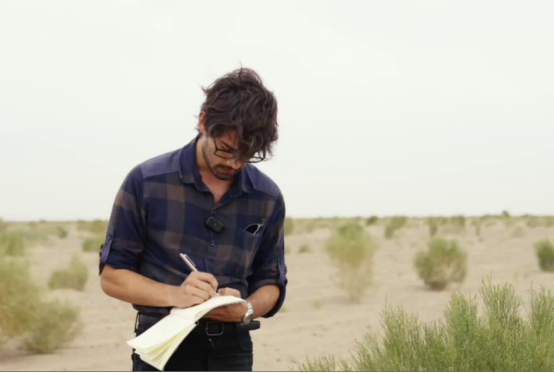
Sci-Tech Empowering Rural Transformation: 2026 Climate Resilience and Green Transition Dialogue participant Gabriel Moreti takes notes at a saxaul plantation in Jinta during a field visit on June 5.
Beneath the saxaul trees the desert-broomrape (Cistanche deserticola, a parasitic medicinal herb) has become a source of steady income for local communities. For a county where 64% of the land is classified as desertified, the endeavor is not just an ecological achievement– it is an economic lifeline.
The Sci-Tech Empowering Rural Transformation: 2026 Climate Resilience and Green Transition Dialogue brought together UN officials, diplomats, researchers, and local practitioners to examine a question with global resonance: Can the fight against desertification pay for itself?
Global crisis, Jinta’s response
The urgency of the question is well documented. A 2025 assessment by the United Nations Convention to Combat Desertification (UNCCD) found that up to 40% of the world’s land is already degraded, directly affecting 3.2 billion people and costing the global economy between US$878 billion and $900 billion every year. The World Bank warns that if current trends hold, an additional 16 million sq. km of land – an area the size of South America – could be lost by 2050.
Yet in Jinta, the numbers tell a different story. The county averages just 39 mm of annual rainfall – approaching the aridity of the Sahara’s desert margins – with evaporation significantly exceeding precipitation, placing it firmly in the hyper-arid category. Over the past two decades, more than 56,700 ha of afforestation has been completed and about 35,900 ha of sandified land has been protected in the county, however. The desertified and sandified land in its borders has been contracting for more than 20 consecutive years. How this happened offers a window into what is quietly becoming a distinctly Chinese contribution to global desertification governance: a system designed to generate income on top of halting the sand.
The tree, the herb, and the man who connected them
At the center of this transformation is the saxaul (Haloxylon ammodendron) tree. Native to Central Asian deserts, it does not need fertilizer and thrives on remarkably little water. The plant is irrigated sparingly and only a few times a year– a reflection of how closely the planting strategy is tailored to the limits of the landscape.
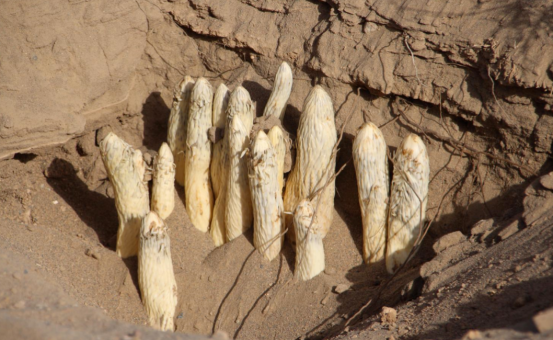
Desert-broomrape (Cistanche deserticola) emerging from the root zone of a saxaul tree in Jinta on June 5
Beneath the saxaul trees, people involved in Jinta’s campaign to engage in desert control complete with a self-sustaining economic model inoculate the roots with seeds of the desert-broomrape, a parasitic plant with no chlorophyll that lives almost entirely underground attached to the saxaul’s roots. It requires no additional water, soil, or fertilizer and emerges from the surface after about three years. Local farmers explained that fresh desert-broomrape sells for 35 to 40 yuan per 500 grams and that dried and gift-boxed products command considerably more.
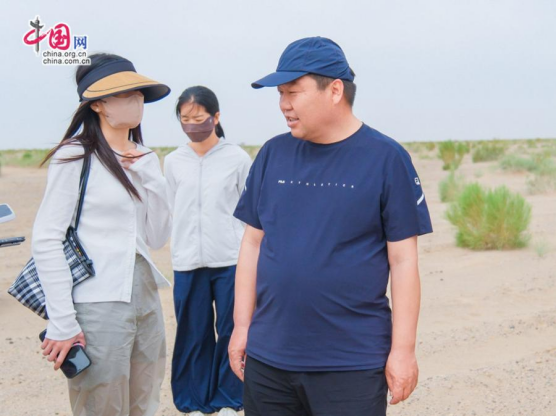
Hu Bing, chairman of an organization known as the Desert Agroforestry Ecological Industry Company (right), speaks to Sci-Tech Empowering Rural Transformation: 2026 Climate Resilience and Green Transition Dialogue participants during a field visit to a saxaul plantation in Jinta on June 5.
The inoculation technique was originally developed by researchers at the Xinjiang Institute of Ecology and Geography, Chinese Academy of Sciences, and proven effective along the edges of the Taklimakan Desert. A man named Hu Bing introduced the technique in Jinta and turned it into an economic engine in the local area. Over a decade ago, he started planting saxaul with local villagers with no clear economic model beyond stopping the sand, however.
“When he successfully introduced and scaled up the desert-broomrape inoculation into the root zone of established trees technique, the logic of the whole project shifted,” Moreti wrote in his field report.
Hu’s company has inoculated over 10,700 ha’s worth of the tree with desert-broomrape and 2,000 ha’s worth with another parasitic plant known as the Suo Yang (Cynomorium songaricum, a perennial flowering plant) and currently achieves an annual harvest of around 2,000 tons of the crops, making it one of the largest cultivation bases of its kind in China. The company has created over 120 jobs in the area, made it possible for 84 households to emerge from poverty as their average incomes increased by more than 36,000 yuan, and donated over 1.2 million yuan to educational causes.
The funding that bridged the gap
Moreti noted a key challenge: “Ecological restoration must generate its own income, or it stalls when external funding does.” Before desert-broomrape harvests can begin, however, saxaul trees must first take root – a process that requires years of upfront investment. The funding behind Jinta’s initial, large-scale planting came from an unexpected source– the daily habits of hundreds of millions of smartphone users.
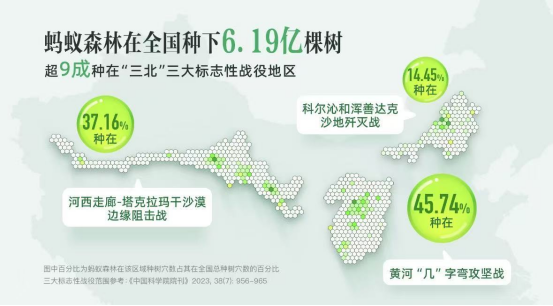
A map depicting the distribution of the over 619 million trees planted by Ant Forest – an organization that was launched by the Ant Financial Services Group, an affiliate of e-commerce company Alibaba, engaged in greening and afforestation as well as other forms of environmental protection that also encourages people to adopt environmentally friendly lifestyles – across China. More than 90% of the trees are located in the core areas targeted by the Three-North Shelterbelt Program’s (also known as the Great Green Wall) three landmark campaigns: the battle along the edge of the Hexi Corridor–Taklimakan Desert, the battle to eliminate the Horqin and Hunshandake sandy lands, and the battle in the bend of the Yellow River.
An organization that was launched by the Ant Financial Services Group – an affiliate of e-commerce company Alibaba – known as the Ant Forest Foundation has engaged in greening and afforestation as well as other forms of environmental protection since 2016. A platform run by the organization enables users to receive green energy points when they engage in low-carbon actions, such as walking, cycling and taking public transportation. Users can apply to have a real tree planted that is funded by the Ant Forest Foundation when they have accumulated a certain amount of points. Over the past decade, Ant Forest has mobilized over 700 million users, planted over 619 million trees, and channeled more than 4.5 billion yuan (US$620 million) into ecological projects across 25 provincial-level administrative areas in China, including the planting of more than 23 million saxaul trees across over 15,300 ha of land in Jinta alone. In 2019, the initiative received the UN Environment Programme’s Champions of the Earth award – the UN’s highest environmental honor.
“This means one in every two people in China has planted a tree in the northwest through Ant Forest [on average],” Wang Xiaoying, secretary-general of the Ant Forest Foundation, remarked at the Sci-Tech Empowering Rural Transformation: 2026 Climate Resilience and Green Transition Dialogue.
The China Green Foundation – a civil society organization that promotes greening and afforestation as well as environmental awareness – oversees operations, while local enterprises, such as an organization known as the Desert Agroforestry Ecological Industry Company, handle planting and technical implementation. Behind these efforts, the Jinta County government has worked to align municipal and provincial forestry authorities, channeling public investment into desertification control and helping build an integrated industrial chain that spans planting, processing, sales and research.
From Gobi gravel to greenhouse: farming the unfarmable
Jinta was not presented as an isolated experiment at the Sci-Tech Empowering Rural Transformation: 2026 Climate Resilience and Green Transition Dialogue. The event also highlighted another approach to turning ecological constraints into productive assets: Gobi Desert eco-agriculture in neighboring Suzhou District.
The district is the birthplace of Gobi Desert eco-agriculture. Over more than two decades of continuous innovation, it has evolved into the largest Gobi greenhouse production base in China. Vegetables are grown across more than 20,000 ha of land year-round, including in solar greenhouses and steel-frame tunnels across 6,200 ha of land. Cooperative models linking enterprises, cultivation bases, and farming households have enabled some 18,000 households to get involved with the vegetable farming industry – making it a cornerstone of local rural vitalization.
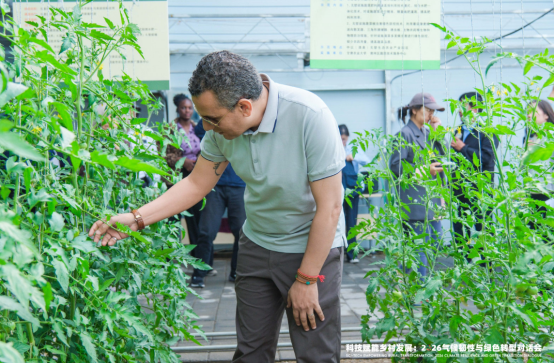
A Sci-Tech Empowering Rural Transformation: 2026 Climate Resilience and Green Transition Dialogue participant examines plants at the Gobi Desert solar greenhouse industrial park in Jiuquan city’s Suzhou district on June 6.
The greenhouses in Suzhou do not occupy arable land and thus do not compete with local grain production. Organic substrate made from fermented crop straw, vegetable waste, and livestock manure is utilized, which helps make it possible to consume around 60% of the fertilizer and less than 50% of the water that open-field farming requires. A core innovation is known as the “sandwich cultivation technique,” which involves layering an impermeable membrane, organic substrate, and sand directly onto the Gobi surface, with the bottom layer staving off salinity, the middle providing nutrients, and the top helping to retain moisture and regulate temperature.
The International Fund for Agricultural Development (IFAD) is in the process of modernizing 682 aging greenhouses at the park and has been making sure that local farmers benefit from the improvements.
“IFAD has always been committed to promoting climate-adaptive technologies and ensuring that the most vulnerable groups are not left behind in the green transition,” Nii Quaye-Kumah, IFAD China representative, stated during the Sci-Tech Empowering Rural Transformation: 2026 Climate Resilience and Green Transition Dialogue.
Exporting the model: from Gansu to Africa’s great green wall
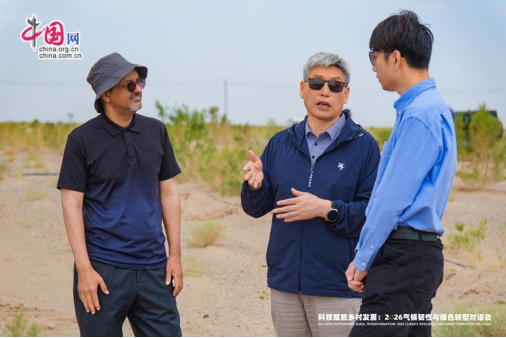
Mohamed Abdellahi El Vilaly (left), ambassador of Mauritania to China, listens to desertification control expert Lei Jiaqiang (center) explain environmental protection and economic development strategies suited to desertified areas during a field visit to Jinta on June 5.
The environmental protection and economic development model that Jinta has implemented is already spreading. Lei Jiaqiang, a desertification control expert at the Xinjiang Institute of Ecology and Geography, Chinese Academy of Sciences, mentioned that China has established international cooperation platforms with Africa, Mongolia, the Arab states, and Central Asia and created pilot bases along Africa’s Great Green Wall– an initiative designed to restore the continent’s degraded landscapes and transform millions of lives in the Sahel region – when he spoke at the dialogue.
Charymuhammet Shallyyev, director of the Central Asia Regional Economic Cooperation (CAREC) Institute– an intergovernmental organization dedicated to promoting economic cooperation through knowledge generation, capacity building, and knowledge sharing in the CAREC region with a mission to support shared future and sustainable development in the region and beyond that serves as an arm of the CAREC Program, a proactive facilitator of practical, results-based regional projects and policy initiatives critical to sustainable economic growth and shared prosperity in the CAREC region– saw an environmental protection and economic development model with clear cross-border potential.
“Rather than investing in desert management with little economic return, the model unlocks the potential of desert land resources by combining ecological restoration with local specialty industries,” he observed.
Shallyyev stated that decades of practice in Gansu and Xinjiang Uyghur Autonomous Region have produced “a full set of proven, scalable, and cost-effective solutions” that “fit perfectly with natural conditions in Central Asia.”
For Mauritania, where over 84% of the land is threatened by desertification, the cooperation that is occurring is more than symbolic. Mauritanian Ambassador to China Mohamed Abdellahi El Vilaly expressed deep appreciation for China’s support in desertification control and sustainable development and voiced hope that China’s expertise could benefit more countries across Africa through mechanisms such as the Green Belt and Road Initiative, which involves development projects aligned with the 2030 United Nations Sustainable Development Goals that also present climate action-positive investment opportunities, during closing remarks that he delivered at the Sci-Tech Empowering Rural Transformation: 2026 Climate Resilience and Green Transition Dialogue.
The return of the beetle: a sign of ecological recovery
Walking through the saxaul plots, Moreti noticed something that might escape a casual observer. “A small beetle crossed the sand between rows of trees,” he wrote. “For someone trained in soil health, a beetle is a signal. Decomposers return when there is organic matter to decompose, and organic matter accumulates when vegetation begins to stabilize the surface.” Project staff members told him that they now regularly see beetles, lizards, snakes, and birds in places that used to have no animals at all.
Before leaving Jinta, Moreti stood at the edge of one of the parcels of land in the area and looked into the distance. The Badain Jaran dunes sat unchanged – bare rock and sand, silent and movable by the wind. Then he looked down, just a few meters ahead and saw the saxaul trees that now exist – low and unhurried but green and gradually growing.
“I left with the feeling that, in Jinta at least, there is real reason for hope,” he concluded in his report.