Heyang county vitalizes rural economy with specialty agriculture along Yellow River
Chinagate.cn by Jin Ling, March 17, 2026 Adjust font size:
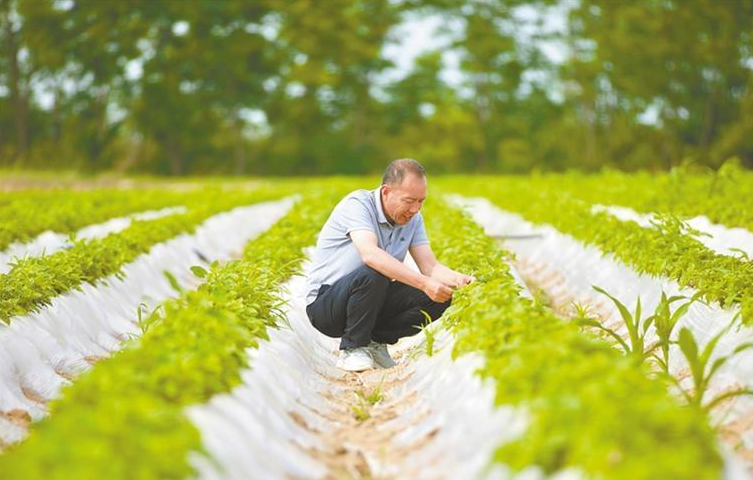
Qin Yanjun, head of a sweet potato cooperative in Heyang county, Weinan city, Shaanxi province, inspects recently planted virus-resistant sweet potato seedlings at a local demonstration field. (Photo by Niu Gang / Shaanxi Daily)
Located on the west bank of the Yellow River, Heyang county, Weinan city, Shaanxi province, recently experienced a vibrant summer season. Vineyards were lush with red grapes, aquaculture ponds rippled with thriving fish as well as crustaceans such as shrimp and crayfish, and sweet potato vines stretched across the fertile land. The sights are part of a larger push by the county to transform its traditional agricultural undertakings into green, branded, value-added businesses and promote high-quality development.
Red grapes and smart farming: upgrading the industry with technology
In Nangou community, Xinchi town, Heyang county, rows of vibrant red grapes hung from flourishing vines. In 2017, grape grower and Heyang-native Qin Gaofeng returned to the area after living elsewhere and planted grapes on 0.67 ha of land that he began leasing. The emerging vineyard became productive after a few years of careful cultivation, and by 2021, he was earning 180,000 yuan (US$25,110) of net income annually, reinforcing his confidence in the business.
Heyang’s unique natural conditions – abundant underground water, potassium-rich soil, and a dramatic difference between daytime and nighttime temperatures – make it ideal for the production of high-quality grapes. These environmental advantages are amplified by scientific support from a site run by Northwest A&F University – a national public agriculture and forestry university affiliated with the Ministry of Education of China located in Shaanxi’s Xianyang city – known as the Heyang Grape Experimentation and Demonstration Station. Standardized processes, from irrigation and thinning to nutrient management, have been widely implemented in the county, and the regional Heyang Red Grape brand, which was launched in the 1990s, has developed and expanded.
Smart farming systems in Nangou’s Fuyuan Modern Agriculture Industrial Zone automatically regulate irrigation and fertilization using real-time data provided by soil and climate sensors.
“Grape growers used to rely on their experience, but the precision-driven, technologically powered farming that we engage in now is easier and more profitable,” vineyard manager Xiao Wanshun mentioned over the summer.
Technology has also been helping with grape sales. Heyang has vigorously pursued e-commerce, and its red grapes are now sold to customers throughout China on various online platforms, including via live commerce. As of late June 2025, red grapes are grown on 10,667 ha of land in the administrative area, with annual output of 180,000 metric tons being achieved and production value exceeding 2.2 billion yuan (US$306.9 million). Valued at 1.39 billion yuan (US$194.46 million), Heyang Red Grape is now among China’s top-50 regional fruit brands.
Aquaculture innovation: sustainable growth along the Yellow River
The fish farms located along the Yellow River in Heyang are thriving. Zhang Xiaodong, a veteran fish farmer originally from Kaifeng city, which is located in neighboring Henan province, has operated in Heyang since 2012.
“The abundant geothermal resources that exist here keep the water around 29℃ year-round, which contributes to firm, high-quality fish that sells well,” he noted.
The county’s 10,467 ha of mudflats make it one of Shaanxi’s primary aquatic farming bases. More than 3,000 people work in the industry, and nearly 29,800 metric tons of fish are produced annually, contributing 528 million yuan (US$73.66 million) in comprehensive annual output value.
A local aquaculture company known for its eco-friendly integrated lotus-crustacean farming is one of Heyang’s exemplary businesses involved in the sector. Its signature crayfish and nine-holed lotus roots generate more than RMB3 million (US$418,500) of revenue per year as of mid-2025.
“We’ve built long-term partnerships with over 200 agricultural markets, seafood wholesalers, and high-end restaurants,” Li Kuilong, head of a Heyang seafood company’s distribution department, stated. “Sea animals can be caught in the morning, sorted midday, and delivered to customers by evening.”
Heyang has also been embracing innovations such as land-based recirculating aquaculture systems – closed-loop, indoor tank systems that minimize water use and maximize efficiency – and integrated fish-crustacean polyculture, which promotes ecological balance and resource optimization. The local fishery sector has been enhancing its value and expanding income opportunities for residents via pilot demonstrations, value chain expansion, branding and innovation.
Sweet potatoes turn gold: Industry chains extend and form clusters
Known for their sweet flavor and fragrant quality in addition to being rich in vitamins as well as minerals such as potassium, selenium, and calcium, Heyang’s sweet potatoes were recognized in 2020 as one of China’s “Famous, Special, and Excellent New Agricultural Products” – a designation reserved for regionally distinctive crops with strong market potential.
“Our sweet potatoes yield about 45,000 kg per ha and sell out quickly,” Qin Yanjun, head of a local sweet potato cooperative, noted.
Researchers at the Heyang County Jufengyuan Sweet Potato Expert Workstation – a facility featuring the expertise of Shaanxi Baoji Academy of Agricultural Sciences, Shandong Academy of Agricultural Sciences, and Northwest A&F University that introduces excellent varieties of sweet potatoes and promotes advanced management technologies such as scientifically formulated fertilization, water-saving irrigation techniques, and advanced farming methods in order to help the farmers in the area increase their incomes and become more prosperous – are developing virus-free seedlings, including a variety with improved root strength and greater overall resilience that is currently under development known as Heyang No. 1. A complete industry chain covering everything from varietal development and seedling propagation to cultivation, processing, and branding has been built with support from Northwest A&F University.
Sweet potatoes are being farmed on more than 2,133 ha of land in Heyang as of mid-2025. Six demonstration bases and more than 30 processing lines now produce vermicelli, dried chips, and other value-added products. The industry’s total annual output value exceeds 175 million yuan (US$24.41 million), and a distinct regional agri-business cluster has taken shape.
“Next, we plan to develop high value-added products, such as sweet potato protein powder and dietary fiber supplements in order to enhance profit,” Qin concluded.