Shanghai's last newsstand finds new lease of life
China Daily, March 05, 2026 Adjust font size:
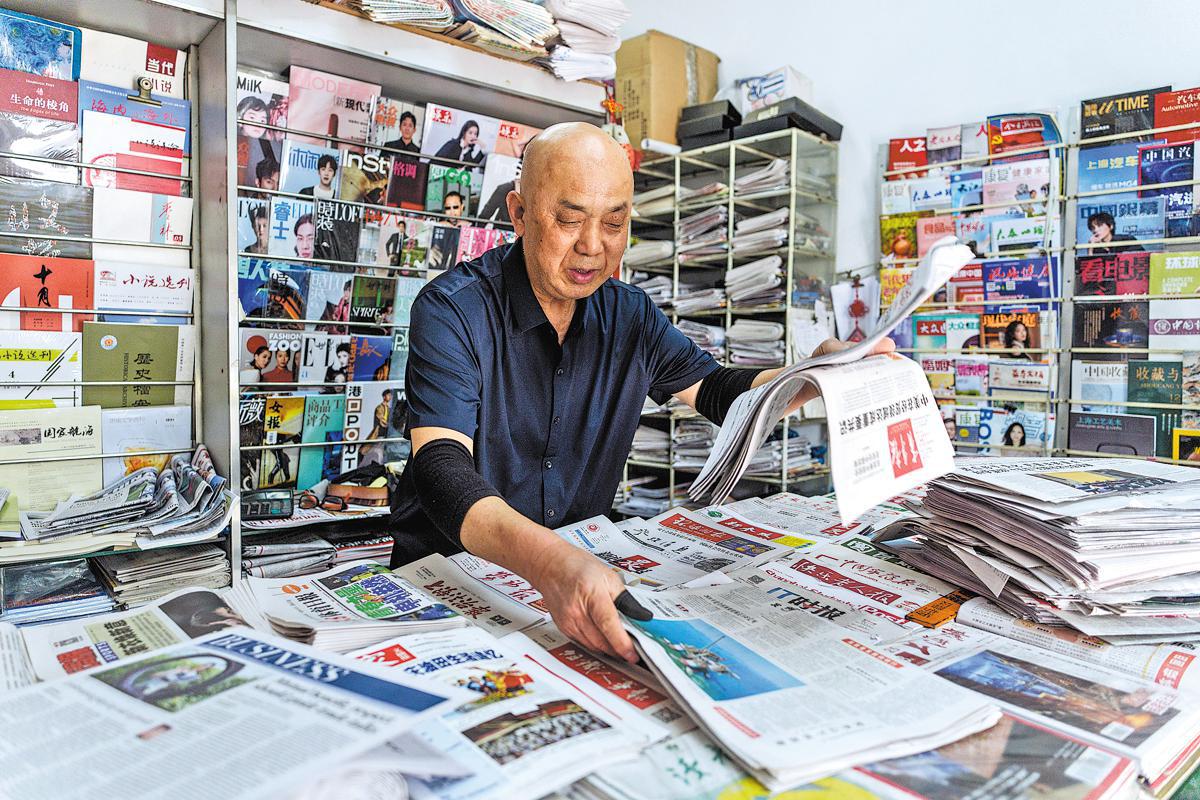
Jiang Jun organizes different newspapers at the newsstand's old location at Wusong Road in Shanghai's Hongkou district last year. GAO ERQIANG/CHINA DAILY
Shanghai's last remaining newsstand is experiencing what the operator called "its best business" in history following its relocation on New Year's Day, which attracted significant media attention and drew in both new and returning customers.
The newsstand operator, 67-year-old Jiang Jun, who has dedicated his life to selling newspapers, said that since the move, daily foot traffic has nearly doubled, with a noticeable increase in younger customers. The shop's location on Hongkou district's Zhapu Road, which is not far from the Bund, has allowed it to become a popular weekend destination for young residents and tourists.
This newsstand, which has been in existence for more than two decades, is dubbed a "living fossil" of Shanghai's print retail industry by local media.
"I have been selling newspapers for 38 years, not out of personal perseverance, but constantly driven by the demand from readers," said Jiang, a Shanghai native.
"The presence of these readers reassures me that even in today's media landscape dominated by new media, traditional print still holds irreplaceable market and social values," he said.
Jiang started managing print retail in the postal system in 1988. Two years later, he was recognized as a national model worker in the postal system for selling 600,000 newspapers annually and generating nearly 120,000 yuan ($17,200) in revenue. For decades, his daily routine was to set out at 4:30 am every morning to pick up newspapers from the printing factory, open his shop before 6 am, and work until after 6 pm, without taking a single day off all year round.
In 2019, when he was supposed to retire at age 60, the closure of thousands of newsstands in Shanghai, due to the impact of new media and disordered business models, left this newsstand, located 200 meters from his current shop, as the last remaining in the city.
To ensure readers could still purchase newspapers offline, Jiang chose to postpone his retirement and continue managing the stand.
"By that time, I had worked at the shop for 32 years. I devoted a lot of effort to this job. I didn't take a single day off, working 14 hours a day on average, and sometimes even up to 18 hours," he said.
Last year, due to age and labor regulations, Jiang and the leaders at the postal system reached an agreement to close the shop by year's end. However, the closure notice on the door sparked public interest, leading to offers of rent-free locations from various district governments, office parks and cultural institutions. Eventually, the shop relocated to a site near Shengli (meaning victory) Cinema in a cultural zone. This site is provided by the cinema for free.
Jiang explained that he chose this location because it is close to the original store, making it convenient for long-time readers to find. Additionally, the current shop is over 30 square meters, which is more spacious than the previous one, allowing for more display racks for newspapers and magazines, and making it easier for readers to come in and browse. In the shop, readers can find over 1,000 different newspapers and magazines.
The relocation has been widely covered by the media, drawing visitors of all ages. A primary school student, after watching a live broadcast by local media from the store, specifically came to visit with his father. The boy purchased 424 yuan worth of newspapers and magazines, including those on science and humanities.
"We encourage the child to read more books and spend less time on electronic devices, but such advice comes in vain all the time. This time, however, the child took the initiative to buy newspapers and magazines, which we parents believe is very positive for his development," said Qi Feng, the father, 42.