China urges US to stop suppressing Chinese companies
Xinhua,October 30, 2019 Adjust font size:
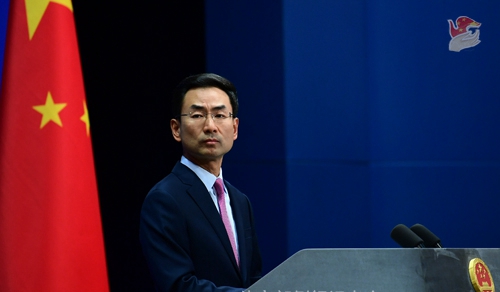
Foreign Ministry spokesperson Geng Shuang [Photo/mfa.gov.cn]
A foreign ministry spokesperson on Tuesday urged the United States to stop generalizing the concept of national security and unreasonably suppressing certain Chinese companies.
"We firmly oppose the United States abusing its state power and suppressing particular Chinese companies without any evidence. Such economic bullying behavior goes against the principle of market economy which the United States has always claimed to champion, nor shall it win the support of the international community," spokesperson Geng Shuang said at a press briefing.
Geng made the remarks in response to a question concerning expected vote by the U.S. Federal Communications Commission in November on whether to designate Huawei and ZTE as national security risks. If the answer is yes, U.S. rural telecom carriers will be barred from buying Huawei and ZTE products using an 8.5-billion-U.S.-dollar government fund.
Citing U.S. media reports, Geng said the U.S. Rural Wireless Association has estimated that 25 percent of its members have Huawei and ZTE equipment in their networks, and that replacing them would cost 800 million to one billion dollars.
Banning Huawei and ZTE will end up hurting the interests of U.S. companies and consumers, Geng said.
He noted that for a large majority of countries, the cases of the PRISM program and Alstom are still fresh in their memories, but until now, the United States has not given a clear explanation to the international community.
Geng urged the United States to provide a fair, just and non-discriminatory environment for Chinese companies operating in the United States and do more to advance mutual trust and cooperation between the two countries.