Yuan Reference Rate Hits High
China Daily, May 9, 2013 Adjust font size:
The State Council, China's cabinet, said this week it will draft an operational plan to achieve full convertibility of the yuan and establish a comprehensive system for individuals' outbound investments.
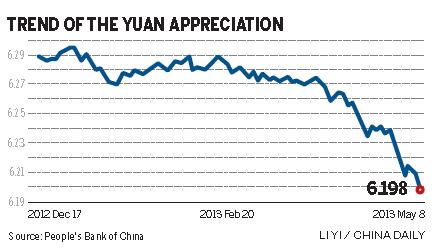
Analysts have forecast continuous appreciation pressure on the yuan as major economies announced a new round of monetary easing. On Monday, the central bank of Australia said it will cut interest rates by 25 basis points, following the steps of the European Central Bank and the Indian central bank.
China has seen four straight months of net foreign exchange purchases among the central bank and commercial lenders, which suggests continuous capital inflows.
The central bank data showed that banks brought in nearly 236.3 billion yuan (US$38.25 billion) worth of foreign exchange in March on a net basis, boosting the total yuan holdings for purchasing foreign currency to nearly 27.1 trillion yuan.
Apart from international "hot money" inflows, the rising willingness of Chinese companies, especially property developers, to sell dollar-denominated bonds in overseas markets also contributed to increasing cross-border money inflows, said Ding Zhijie, dean of the School of Banking and Finance at the University of International Business and Economics in Beijing.
Expectations of the yuan's appreciation have also strengthened as China's band-widening discussions have been rekindled following recent comments from PBOC officials indicating that the yuan trading band will be further widened "in the near future".
And the tightening of foreign exchange rules this week could well lay the groundwork for a band-widening move later this year, said Australia and New Zealand Banking Group Ltd in a report.
On Sunday, the State Administration of Foreign Exchange rolled out new rules to regulate the banks' dollar net open positions, or NOP, linking their onshore foreign exchange loan-to-deposit ratios with the regulated NOP floor.
It also called for stricter scrutiny of foreign exchange transactions by exporters and importers.
The new SAFE rules do not alter the fundamental reasons behind yuan appreciation, but rather eliminate the speculative elements seeking to profit from the appreciation, said Li Wei, a senior economist at Standard Chartered Bank.
"China's modest external surplus, favorable interest-rate differentials and the role of the yuan appreciation in internationalization continue to favor gradual appreciation medium-term," he said.
Ding said that it's still possible that the yuan will go down for a while after this phase of appreciation, as the negative impact of Japanese yen's depreciation on East Asian countries' trade balance will gradually loom large, leading to currency depreciation among these countries.